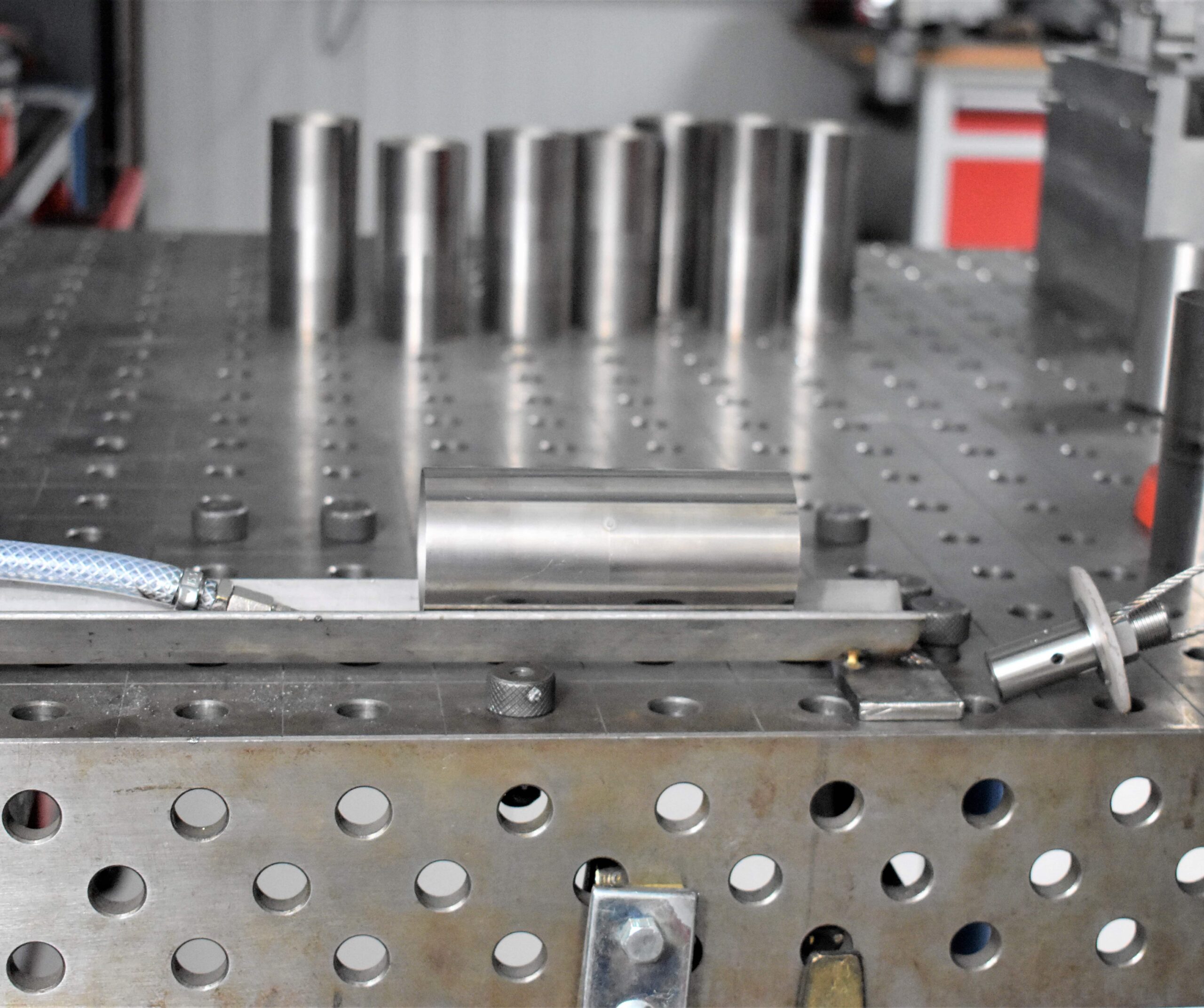
The choice of shielding method will depend on the application. For tube welding, the simplest method is balloon or puddle containment. Groove containment is used for linear welds. If the configuration is more complex, the use of a trailing torch – a versatile tool that is easy to set up – is recommended, provided that the welder can intervene directly.
What techniques and different tools can be used to measure
the level of oxygen remaining in a tube?
An oxygen meter is a tool that measures the amount of oxygen in the ambient air. This value, the amount of oxygen remaining, is expressed as a percentage. It can be useful when going down a sewer for example, seeing as they emit gases. As carbon is heavier than oxygen, it is vital to check the oxygen level while going down to avoid danger zones.
For welding, it is crucial to be able to measure the residual oxygen level in the air at all times, which should not exceed 0.0001%. If a device is used that measures between 0 and 20 %, the welder will not be able to know whether the threshold value for welding has been reached. It is obvious that this type of device is not at all suitable for executing welds and that it makes more sense to use a PPM (parts per million) reader. This tool delivers a much higher accuracy by measuring up to the fourth digit behind the decimal point.
At what oxygen level should the weld be started?
Root porosity occurs at an oxygen level of 500 to 800 ppm. The discolored part is more than dangerous – at this stage we will assume that the weld has hardly been inert. 800 ppm corresponds to 0.08% oxygen, a figure undetectable by a standard oxygen meter.
The threshold value, meaning the accepted percentage at which the weld will be triggered, can be configured precisely to meet the requirements of the specification. For sensitive industries such as the pharmaceutical industry, welding will be done with oxygen levels below 100 ppm, resulting in a very clean weld. For the strictest environments, the accepted values will sometimes be at only 20 ppm. AXXAIR power supplies provide the user with a table showing the different colors according to the oxygen level in ppm.
How much does a PPM reader cost?
Needless to say, you should not pinch pennies when it comes to investing in a tool like this. Basic oxygen meters are available from 100 Euros, while a PPM reader will cost between 700 and 3000 Euros. It is more than obvious though, that these two products cannot be compared.
This very precise tool is more than necessary when welding at very high standards. For more basic applications where inerting does not play such a crucial role, it can of course be done without one. This is why AXXAIR offers this equipment as an optional add-on for the entire range of its orbital welding power supplies.
How to choose the proper shielding gas
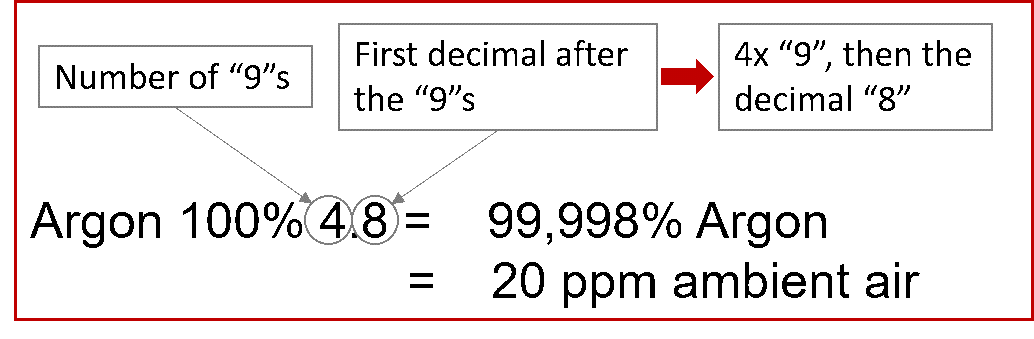
Gases are classified according to their purity, described by a two-digit label: 4.6, 5.2, 6.0 etc. The first digit corresponds to the number of “9”s and the second digit expresses the first number after the “9”s. So the purity of a gas described with 4.8 corresponds to a gas whose fourth digit will be an 8. If the user buys 100% argon, the gas will be 99.998% argon.
As a consequence, the other 0,002 % are the 20 ppm of ambient air, made up of about 20% oxygen and the other gases in the atmosphere. The choice of gas and its purity must be in line with customer requirements.