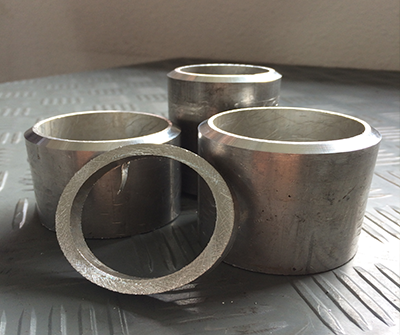
Let us return to the question of the bevel, which will reduce the thickness of the tube in order to allow welding. Generally speaking, a tube with a wall thickness of more than 3 mm cannot be welded with only one layer in TIG welding.
TIG welding is a Tungsten Inert Gas process: Tungsten designs the electrode and Inert Gas the plasmagenic gas used for shielding.
In order to weld thicker pipe, a bevel must be carried out at one edge of the tube to be welded to another pipe / bend / reduction / connections (T,Y), which also have to be bevelled.
The bevelling systems often are of “manual” type.
J or Tulip bevel
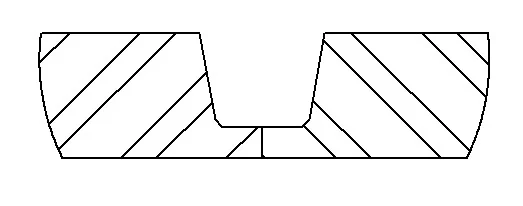
The other technical way of bevelling is called “bevel for orbital welding” and this one is different compared to the J or tulip bevel.
- The shape of the bevel used for orbital welding is different as it has a flat land at the edge of the J or tulip bevel with a thickness of 1,8 to 2 mm. This land will facilitate smoothing and straightening.
- The act of smoothing and straightening consists of realizing a plane reference enabling the machining of the other faces. In this way a finer thickness will be created in the inner side of a tube. Example: A thickness of 8 mm before bevelling and only 2 mm remaining for the land.
- The two lands of the workpieces with a land thickness of 2 mm will be in contact. Only a simple fusion of the lands will be necessary and afterwards the bevel can be filled with filler wire using orbital welding technology.