As a manufacturer and seller of orbital TIG welding equipment, our customers and prospects, as well as our distribution partners, often ask us this question:
Does a change in brand or model of orbital TIG welding equipment, automated or mechanized, warrant a new Welding Performance Qualification (PQR) test?
This is an essential question when you consider the cumbersome nature of all the steps that lead to obtaining a PQR, as well as the financial implications.
In this article, we will provide you with some answers to help you better understand what the standard governing Welding Performance Qualification (PQR) really involves.
1. What are WPS and PQR?
The WPS is the Welding Procedure Specification. It defines all the steps necessary to carry out a particular weld, according to several criteria:
- The type of assembly (sheet metal butt, tube butt, T-bar, etc…)
- Dimensions and thicknesses
- The welding method
- The welding position
- The filler material (if any)
- Type of current (AC, DC or pulsed)
- Pre-heating, inter-pass or post-heating temperatures
- Heat treatments
It is a very complete and precise description of the weld. Its purpose is to allow the repeatability of a weld once it has been validated for a given application.
The PQR is the Welding Performance Qualification, i. e. a report justifying the validity of a WPS for a given application.
Simply put, the WPS is the recipe, the PQR is the validation of that recipe.
Passing a PQR involves the visit of a welding inspector working on behalf of a Notified Body, during which the entire Welding Procedure Specification (WPS) is presented to him. Several samples are provided to the inspector and are then examined in the laboratory to be validated.
It is important to know that, depending on the certified Bodies, a PQR costs the customer from 782 to 1118 dollars depending on the tests carried out in the laboratory, plus the inspector’s per diem, which comes up to about 838 dollars per day.
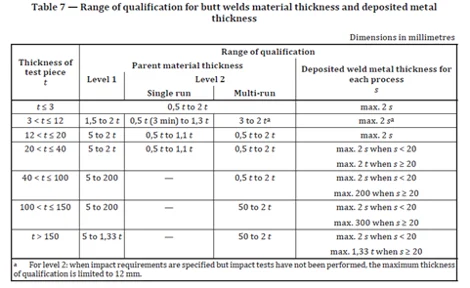
There are two levels of qualification: a generic and not very restrictive level 1, and a more restrictive level 2 requiring more testing. If the level not specified, the requirements of level 2 apply.