
When it comes to orbital TIG welding, the seam preparation is essential in order to obtain optimum quality weld.
Here you can find information exploring, the standardized codification as well as types and modes of assembling.
Welding thin tube
A weld seam preparation is not needed for tubes with a small wall thickness of less than 3 mm (less than 0.118”). For thicker tubes weld seam preparation is a must to ensure good welding execution.
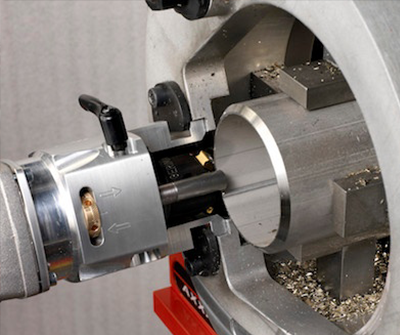
During the squaring operation, a tool machines the end of the tube. Every time a highly precise surface finish quality is required, tube squaring is the best solution.
What about thicker tube ?
When welding a joint with a bevel, several welding passes will be necessary during the orbital welding process. Different end preparations will be used to weld J or V bevels.
Read more about the importance of pipe end preparation bevel before welding.
We do not recommend a V bevel in orbital TIG welding, as the final result will not be acceptable. The weld seam will have a hollow root and a negative penetration. In order to avoid this, you would choose a J bevel with a land of about 2 mm / .080” (according to the thickness of the tube). Then you will need to fill the groove.
So, two kinds of preparations are compatible:
- Tulip (J Bevel) without counterboring : pipe between 3 and 10 MM / .118″ – .390″ wall ( for reference only)
- Tulip bevel with counterboring: pipe thickness > 10 MM/ >.390″ wall
Counterboring consists in a slight machining of the internal diameter of the pipe in order to guarantee an equal thickness of the land at any point.
In fact, differences of the thickness of the land can also lead to irregular thicknesses at the edge of the tube.