


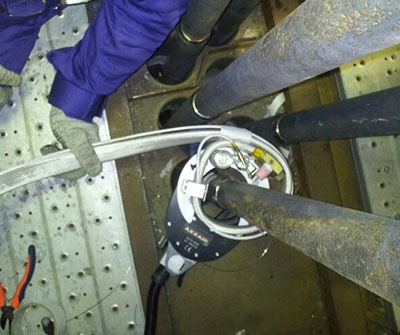
Open welding heads are characterized by their flexibility to weld different diameters and wall thicknesses of tubes and pipes.
However, apart from the financial aspect, it must be taken into account some specific applications simply cannot be welded with closed welding heads due to the geometry of the parts.
>> When to use an open welding head? <<
Why should you use an open welding head?
Tube and pipe with large wall thicknesses require special attention.
Unlike thin-walled stainless steel tubes that can be fused by butt welding, stainless steel and black steel pipe with thicker wall need to be beveled before they can be welded. In orbital welding, welders usually opt for a J-bevel. During the welding process, this bevel needs to be filled in with filler material. However, with the use of an open welding head this task can be carried out with additional functions such as oscillation of the torch or AVC (Arc Voltage Control).
This is an open heads primary application. After a first so-called “root” pass, the electrode of the open head makes several passes around the tube, filling the bevel with the filler metal. This would be impossible to do with a closed head.
The weld pool and the weld bead are protected with shielding gas. Since you are working with an open head, the gas can escape into the air. As a result, you’ll have a higher gas consumption which makes the welding more expensive. Perfect control of pre- and post-gas is therefore particularly interesting for these applications.
Be sure to pay attention to your surroundings! When welding with open heads, it is important to avoid any kind of exterior interference such as draughts for example. They may deflect the shielding gas.
Below we listed 4 applications for which you should opt for open welding heads.